





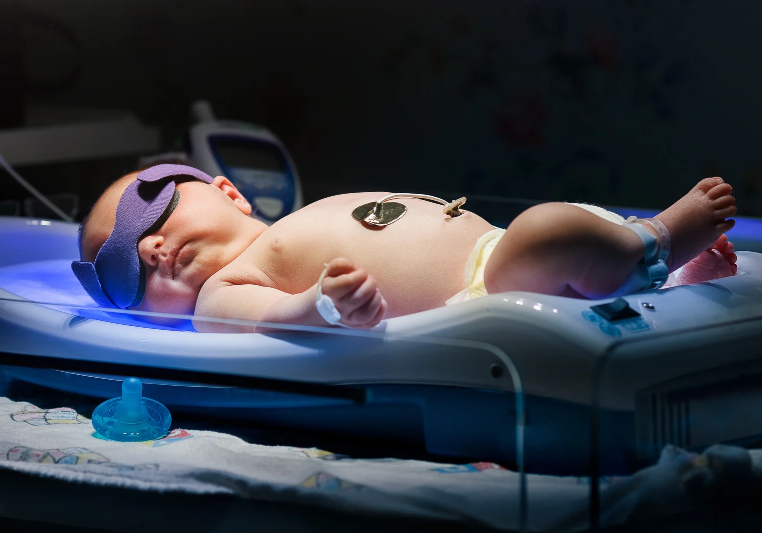
The Dangers of Undiagnosed or Untreated Infant Jaundice
Most newborns develop mild jaundice within their first few days. According to the American Academy of Pediatrics (AAP), over 80% of newborns experience it. Jaundice is caused by a build-up of bilirubin, but serious complications are rare.
Risks arise when jaundice goes unmeasured, unmonitored, or untreated. Exceptionally high bilirubin levels can cause kernicterus, a type of permanent brain damage leading to movement disorders (cerebral palsy), hearing loss, vision problems, and enamel defects. Fortunately, timely detection and treatment prevent kernicterus in most cases. Here are two critical points from current AAP guidance.
What the AAP’s Current Guidance Means for Your Baby
First, every baby needs a measured bilirubin test before discharge. This test uses a skin light meter or a heel-stick blood sample, typically between 24 and 48 hours after birth (or sooner if discharged early). The blood test can be done using the standard newborn screening heel stick.
Visual inspection alone cannot accurately determine bilirubin levels, and jaundice can be harder to spot on darker skin tones. If a skin check indicates a level near the treatment threshold, a blood test is conducted to guide care.
Second, there is no single danger threshold. Doctors evaluate levels against a risk chart that considers the baby’s exact age in hours, gestational age, and specific risk factors. The threshold where intervention begins is called the treatment line.
The same bilirubin number may be safe for one newborn but require treatment for another, especially for premature infants, babies under two days old, or those with additional risk factors.
The closer a level is to the treatment line, the sooner follow-up testing is needed. The AAP recommends that families receive written and verbal guidance on jaundice before going home, including the date, time, and location of follow-up care. Always request your baby’s specific bilirubin reading, as many newborns need re-testing within 24 to 48 hours of discharge.
Babies Who May Need a Closer Watch
Increased monitoring is required for babies born before 40 weeks or those showing yellowing within their first 24 hours. Inform your pediatrician if a family member required phototherapy or has a blood disorder. Additional risk factors include delivery-related bruising or bleeding under the scalp, maternal-fetal blood type incompatibility, and feeding difficulties.
An inherited condition called G6PD deficiency causes rapid red blood cell breakdown, leading to sudden bilirubin spikes. If your family heritage includes Mediterranean, African, Middle Eastern, or Asian ancestry, notify your doctor. Because many infants with G6PD deficiency have no known family history, universal bilirubin screening is essential.
Frequent feeding helps clear bilirubin. Breastfeed 8 to 12 times daily in the initial days. Avoid supplementing with plain or sugar water, and seek lactation support early if feeding challenges arise.
Warning Signs and When To Get Emergency Care
Jaundice typically starts on the face and spreads down to the chest, abdomen, and limbs. While physical appearance does not reliably indicate severity, worsening or deepening yellow color warrants a medical call. If yellowing appears within the first 24 hours of life, contact your doctor immediately for prompt screening.
Contact your pediatrician immediately if yellowing deepens or reaches the soles of the feet, or if your baby is unusually fussy, struggling to nurse/take formula, or producing fewer wet diapers.
Seek emergency medical care right away if your baby is difficult to awaken, refuses to feed, has a high-pitched cry, arches their back or neck, shows stiff or limp muscle tone, develops a fever, experiences seizures, or has breathing pauses. Critically high bilirubin requires urgent intensive care and potentially specialized blood transfusions.
Consult your pediatrician if jaundice lasts over two weeks in formula-fed infants or over four weeks in breastfed infants, as further testing for liver function may be necessary.
When a Missed or Late Response May Be Someone’s Responsibility
Not every severe case of jaundice results from medical negligence, as clinical decisions are tailored to each infant. However, standard care requires pre-discharge testing, appropriate follow-up planning, and prompt intervention. Discharging a newborn without screening, failing to evaluate early symptoms, or delaying follow-up care can lead to preventable, lifelong harm, potentially giving rise to a legal claim against responsible parties.
This article offers general educational information and does not constitute legal or medical advice. The birth injury attorneys at Sommers Schwartz can evaluate your case, investigate potential medical errors, and outline your legal options. Contact us today for a free consultation.

Richard Groffsky focuses his practice on medical malpractice and personal injury litigation, and has represented victims of devastating brain injuries and birth injuries in Michigan, Ohio, Illinois, Indiana, South Carolina, and Georgia in significant brain injury and birth injury cases.